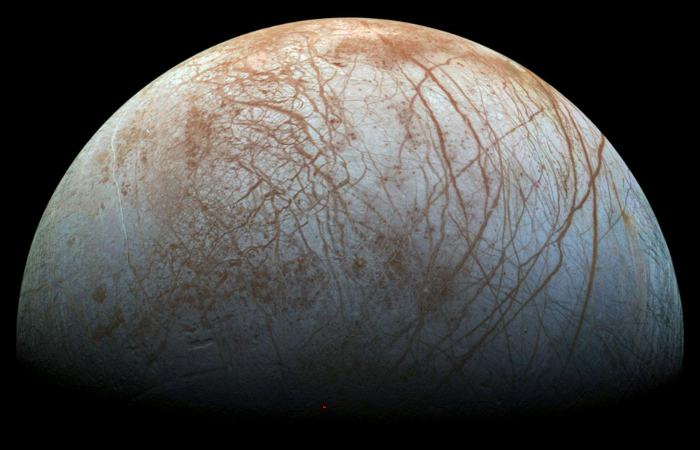
NASA’s Europa Clipper is now on its epic journey to Jupiter, setting course for Europa—a moon believed to hide a vast ocean beneath its thick ice shell. Scientists are hopeful that this hidden ocean could harbor the right conditions for life. The spacecraft lifted off at 12:06 p.m. EDT on Monday, riding atop a SpaceX Falcon Heavy rocket from Launch Pad 39A at Kennedy Space Center, Florida, marking the start of a mission filled with anticipation and discovery.
Europa Clipper Sets Sail
Europa Clipper, NASA’s largest spacecraft designed for planetary exploration, is officially on its way to investigate Europa, a moon believed to harbor a vast ocean beneath its icy surface. This mission marks the agency’s first dedicated effort to study an ocean world beyond Earth.
The spacecraft will cover 1.8 billion miles (2.9 billion kilometers) using gravity assists—swinging by Mars in a few months and returning to Earth in 2026 for an additional boost. Once it reaches Jupiter in April 2030, Europa Clipper will conduct 49 flybys to collect data on the moon’s ocean, ice shell, and potential habitability.
Shortly after liftoff, the spacecraft separated from its rocket, establishing two-way communication with ground control through NASA’s Deep Space Network in Canberra, Australia. Initial reports confirmed that Europa Clipper is in excellent condition and fully operational.
NASA officials emphasized how the discoveries from Europa Clipper will not only build on previous missions like Juno and Galileo but also help advance the search for habitable environments beyond Earth, inspiring future generations of exploration.
Unlocking the Secrets of Jupiter’s Ocean Moon
The primary goal of the Europa Clipper mission is to investigate whether Europa, one of Jupiter’s moons, could support life. Though similar in size to Earth’s Moon, Europa’s interior is believed to hide a vast, salty ocean beneath a thick ice shell—possibly containing more water than all the oceans on Earth combined. Data from NASA’s earlier Galileo mission also suggested the presence of organic compounds and energy sources that could fuel life beneath its surface.
If Europa is found to be habitable, it could reshape our understanding of how common life-supporting environments are, both within our solar system and beyond.
When the spacecraft reaches Europa in 2031, it will conduct 49 flybys, sometimes flying just 16 miles (25 kilometers) above the surface. With nine advanced scientific instruments—including ice-penetrating radar, cameras, and thermal sensors—Europa Clipper will gather insights into the moon’s icy crust, hidden ocean, and atmosphere. The data could reveal recent eruptions of water and warmer areas beneath the ice, deepening our understanding of Europa’s potential to harbor life.
More on Europa Clipper
Europa Clipper’s mission focuses on three key scientific goals: determining the thickness of Europa’s icy shell and how it interacts with the ocean beneath, analyzing the moon’s composition, and studying its geological features. These objectives aim to uncover whether Europa could support life, contributing to the broader search for habitable worlds beyond Earth.
Led by NASA’s Jet Propulsion Laboratory (JPL) in partnership with the Johns Hopkins Applied Physics Laboratory (APL), the mission involves collaboration with multiple NASA centers, including Goddard, Marshall, and Langley. The spacecraft’s core design was a joint effort by APL and JPL, with NASA Kennedy managing the launch operations.
Through detailed flybys of Europa, Clipper will gather essential data, helping scientists unlock the secrets of this distant ocean world and further expand the horizons of space exploration.